
Permission to Not Do the Thing

I truly believe LinkedIn is the best social network, and really the only one I spend time on.
I've been without any Meta platform account for about 16 months now, logged out of TikTok since 2020, and famously only spent 11 hours total on Twitter since it launched. (X for work is a different story, albeit one told from a distance.) I follow my Bluesky feed via RSS (as journalists are rather active on there), but I find the entire experience not unlike the scene in Midsommar where Florence Pugh's character starts crying and the cultists around her mimic her emotions.
Though containing multitudes, the scope of content encountered on LinkedIn is narrower than what one would experience on most other social platforms. This is by design, as LinkedIn is the "largest professional network" that "connect[s] the world’s professionals to make them more productive and successful." If you see someone dancing to a song in a LinkedIn video, the captions almost certainly are work or job related. If you come across content related to bettering one's mental health, it's likely the poster is either a psychologist, working for a related startup, or talking about burnout.
Simply put, you know what you're getting into when you visit LinkedIn. There's a lot of clearly AI-generated founder nonsense, a lot of talk about funds raised and ARR, and a fair amount of posts that took a few revisions to be on brand. This isn't different from any other social network where users put forth a persona; such a thing on LinkedIn is more or less expected, as it's how people display themselves professionally.
People Doing Things
Like many other platforms, LinkedIn is full of people doing things. Celebrating wins. Becoming a better, more focused and well-rounded individual or worker. Displaying hustle, knowledge, or sometimes both. This is not to knock any of this — as I learn a lot from these posts.
Yet there are times when not doing this is important. One cannot celebrate wins, focus solely on bettering themselves, or extoll the virtues of hustle culture at every hour of every day. It is necessary to spend time not doing that and just live, zone out, contemplate, and do something decidedly not post-worthy — lest you wish to burn out quickly.
Doing the Wrong Things
I recently suffered a personal loss that I'm still processing and will continue to process for quite some time. Yet as the loss happened, I kept on with work and took little time off.
(I should note that my employer and all places where I consult were not only supremely understanding of my situation, but had explicitly requested I take as much time as needed to deal with the loss. Despite the incredible generosity shown towards me, I decided to only take a day off.)
This was a horrible mistake on my part. As someone who dealt with more personal losses than normal in my late 20s and early 30s, I know the value of time off and time spent not doing things, focusing instead on what matters more in the moment (read: anything but work). At the same time, I found that, over the last several years, I am someone who has a hard time putting down the phone or laptop — even/especially on vacation — and focusing on things beyond work.
When work feels all-encompassing and the culture of always working is echoed back to you on LinkedIn and elsewhere, it feels hard to turn such a thing off if that is how you spend the vast majority of your waking hours. Suddenly taking a break from that is jarring — much less so than, say, losing a beloved pet (as was my experience), but nonetheless hard to turn off if that is your default mode for some time. In my case, I feel that I did the wrong things: trying to balance work and a personal event simultaneously, not giving myself permission to put the former aside at a critical moment that I cannot get back. It brings to mind Stevens' strict attention to his duties as his father dies in Kazuo Ishiguro's The Remains of the Day, only to consider the ramifications of doing so much later in his life.
Not Doing the Thing
This is not to say you should not do things. One does not progress in life by remaining perpetually inert. Yet much of life should take precedence over work at crucial and important times. This might seem like a given — prioritizing life over work when personal stuff hits the fan — but I'm far from the only person who struggled doing this. When you live in an echo chamber of things only pertaining to working better and harder while doing or attempting to do just that, your priorities get skewed and you will sometimes make the wrong decision at the wrong time.
Thus, decisions that are well within your control — to put work and related matters aside in favor of dealing with "life things" — should always be made with life in mind and putting work aside however you may. That is, to say, permitting yourself to not do the thing. Messages and email will always be there, but the time we have with loved ones is finite.
I have not practiced what I preach here, but I aim to do so in the future. The only reason I share this idea — again, putting work aside when "life happens" — is because I made the mistake of not giving myself the permission to not do things, and feel that those reading this could learn from such an error.
This also extends beyond critical life events. I've recently taken to not opening certain work apps every hour on the hour over weekends and holidays. It's a new idea for me, as I'm used to being "on" all the time. This is because I truly love my job and what I do, though I realize that I must bifurcate Work Scott from Non-Work Scott.
Every day, I wake up with the innate desire to learn at least one new thing — a concept, skill, or fact.
Previously, I saw days where I didn't learn one new thing as a failure. In retrospect, I know now that seeing days where I hadn't learned something new as a failure was perhaps my greatest failure, as it got in the way of slowing down and simply being.
App of the Week: Super Productivity
At first, it appears as though this app completely contradicts everything I just discussed. Truthfully, I've struggled to find a good task management system that works for me. (I've stopped and started Bullet Journals at least a dozen times, and am about to bail on the one I had going since the start of the year.)
Though I absolutely have Shiny Object Syndrome, chasing cool new productivity software and tossing it aside as a newer one comes around, I saw Chris Person mention Super Productivity on Bluesky and decided to give it a shot.
It's open-source, E2E encrypted, and works on all the platforms I use. Most importantly, the interface makes sense for my brain. (It was built for those with ADHD like myself.) Though I have't gone all-in with it yet, I'm absolutely going to throw everything into it over the next week and hope it sticks.
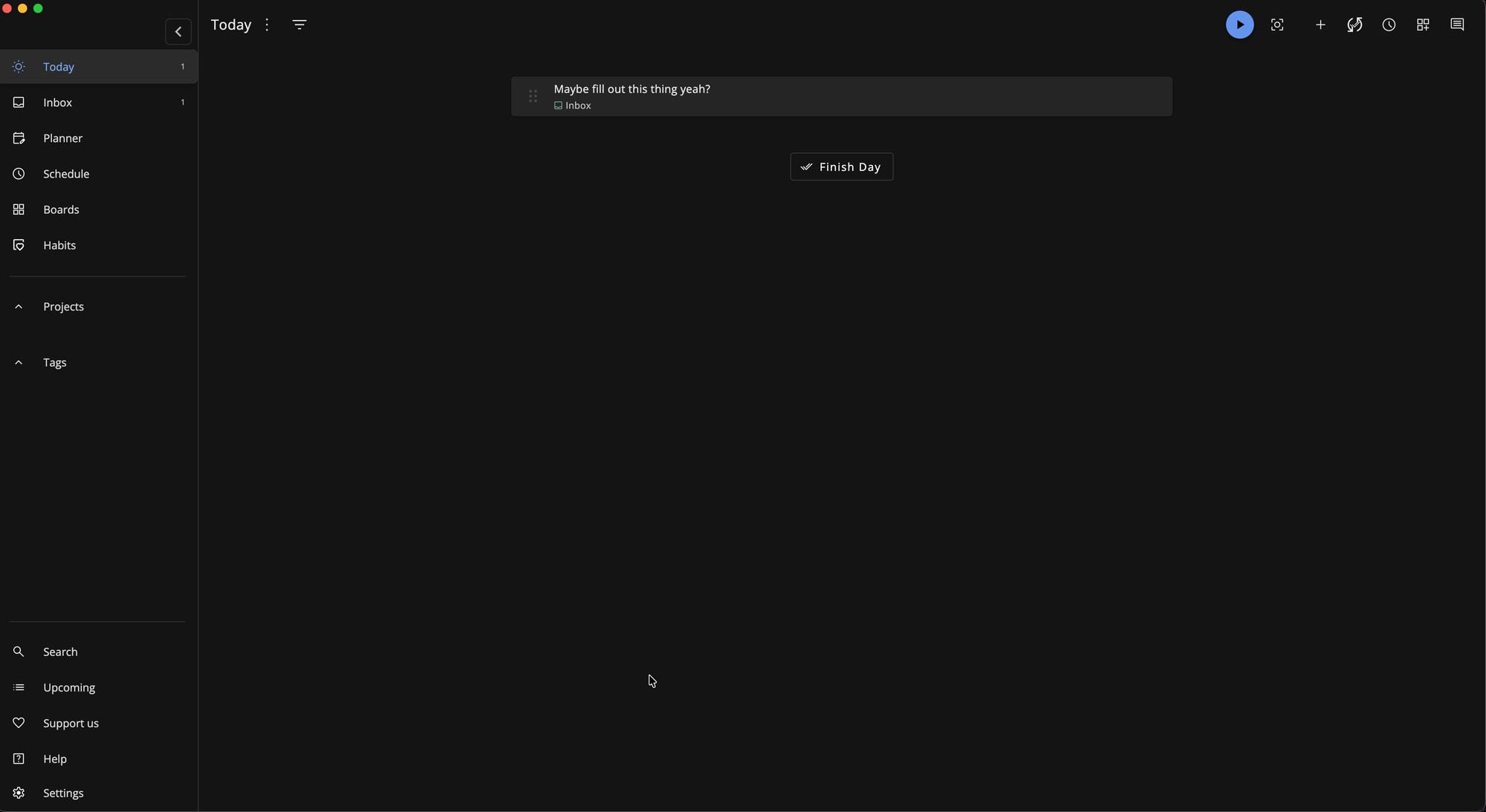
You can learn more about Super Productivity here.
Comments ()